The 212 bps Question: What Static Routing Costs on USD→INR
A 29-day study of USD→INR execution — and why routing profiles don't transfer between corridors.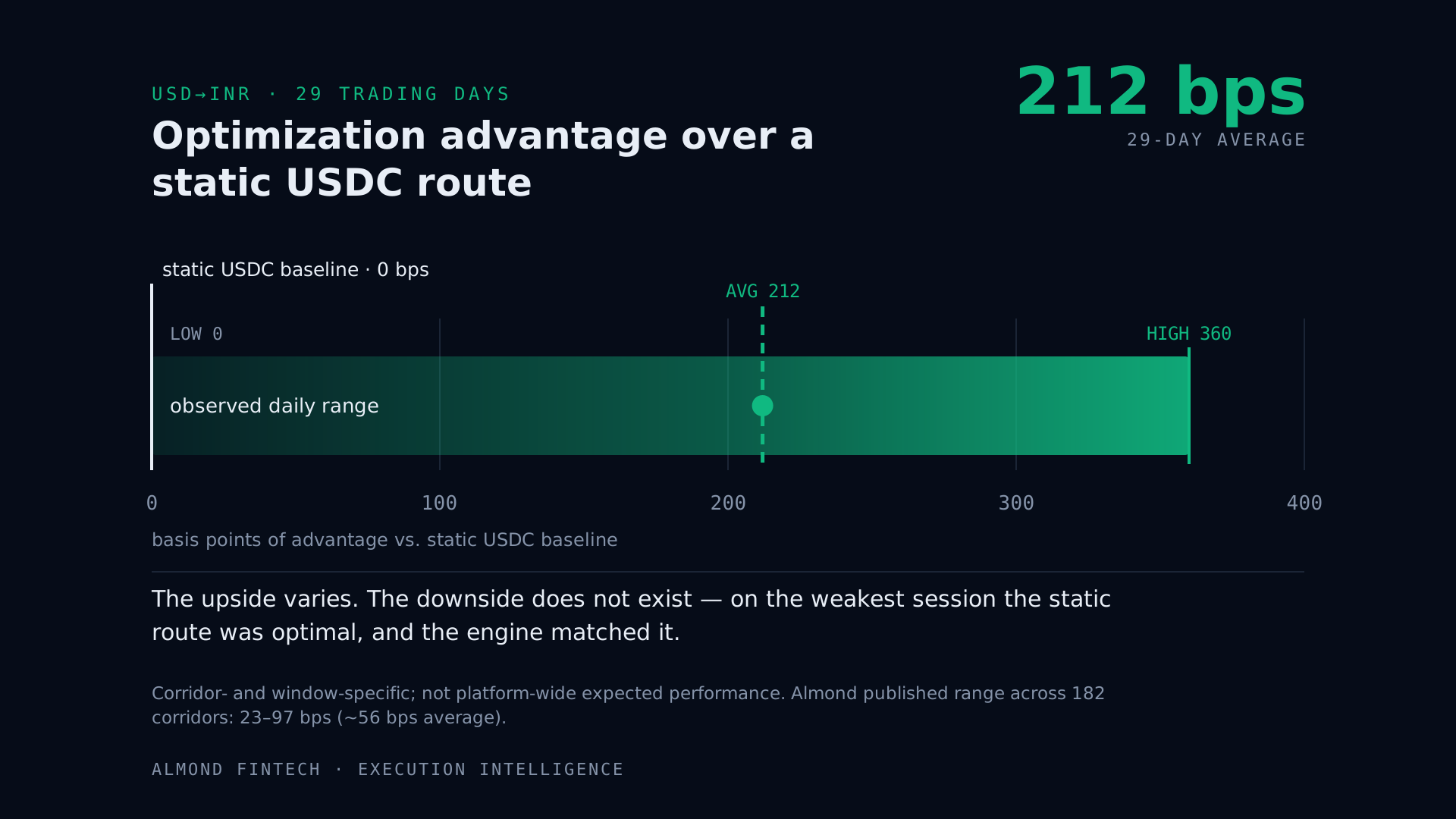
A 29-day study of USD→INR execution found that multi-path routing outperformed a static USDC route by an average of 212 basis points — and that the distribution of that advantage matters more than the average.
India receives more remittance volume than any country on earth: $135.5B in FY25, up 14% year on year, with the United States its single largest source at roughly a quarter of all inflows (RBI). It is one of the most vital arteries in global finance. It is also one of the least optimized.
Most treasury teams moving dollars into rupees route them the same way every time. That is a defensible operational choice. It is also a priced one.
What was measured
Almond benchmarked its execution intelligence engine against a static single-path baseline on the USD→INR corridor across 29 consecutive trading days.
Baseline: a fixed USDC route — one token, one network, one exchange pair, executed on receipt without timing or composition logic. USDC was selected as the baseline precisely because it is the strongest single-path choice available: regulated, deeply liquid, and the token most institutional treasuries already standardize on. The comparison is against best practice, not against a straw man.
Optimized: the same flows routed through Almond's engine, which evaluates each settlement across five dimensions — token, chain, exchange pair, execution timing, and settlement composition — and executes only when a path improves the modeled outcome.
Measured: realized rate advantage in basis points, optimized route versus static baseline, per trading day.
Finding one: certainty is charged daily
Standardizing on a single path buys settlement certainty. One stablecoin, one bank, one predictable operational pattern. The appeal is real, and for teams without orchestration infrastructure it is often the correct decision.
But the price of that certainty is not paid once at procurement. It is charged every day the market moves and the route does not. Over the study window, that daily charge averaged 212 bps.
This is the distinction between access and optimization. Access to stablecoin rails is now commoditized — any treasury team can hold USDC and move it. Optimization of execution is not. A route that cannot respond to liquidity conditions is not a strategy; it is a default.
Finding two: the advantage is asymmetric
The average understates what is actually happening, because it implies a steady toll. The distribution tells a different story.
Across the 29 days, the advantage ranged from 360 bps at the high end down to zero. On the single weakest session, the static USDC route was genuinely optimal for the full day — and that is where the engine routed. It matched the baseline rather than trailing it.
That asymmetry is the structural point. Optimization has variable upside and no corresponding downside, because the static route is always inside the engine's candidate set. When the default is best, the optimizer selects the default. A static route, by contrast, has no good days — only days on which the market happened to agree with it.
What it costs at scale
At $10M routed per month, a 212 bps advantage is approximately $212K. Sustained across twelve months at the same rate, roughly $2.5M.
That annualization assumes the study-window average holds, which no single month can guarantee — corridor conditions shift, and volatility is what creates the opportunity in the first place. It is offered as an illustration of order of magnitude, not a forecast.
Why this corridor beat the platform average
Almond's published performance range is 23–97 bps, averaging approximately 56 bps across active corridors. This study returned 212 bps. The gap is not a revision of that range — it is a demonstration of why a single blended figure is the wrong way to think about routing.
Corridor-level performance is a function of how much fragmentation and volatility exist to be captured. USD→INR combines exceptional volume, meaningful intraday rate dispersion, and a fragmented on- and off-ramp landscape. Corridors that are deep, stable, and efficiently priced return far less, because there is less inefficiency to recover. The platform average blends both.
The operational conclusion follows directly: a routing profile tuned for one corridor is not transferable to another. Firms that treat routing as a single global setting are leaving corridor-specific margin unrecovered by construction.
Routing as a margin discipline
Routing orchestration belongs in the same category as hedging policy and counterparty limits — a margin-protection discipline with defined risk parameters, reviewed on a schedule.
The objective is not the highest available basis-point figure at any cost. It is a routing profile that optimizes margin inside a firm's specific constraints: approved tokens, permitted venues, settlement-time requirements, and counterparty exposure limits. Almond's engine operates inside those constraints rather than around them.
If a firm's routing logic has not been stress-tested against current corridor conditions, the margin is not degrading. It is being left on the table — by design, every day.
How often does your treasury team re-evaluate its routing logic?
Request a corridor benchmark →
Scope and methodology
29 consecutive trading days, USD→INR corridor. Baseline: static USDC route, single network and exchange pair, executed on receipt without timing or composition optimization. Comparison: Almond execution intelligence engine optimizing across token, chain, exchange pair, timing, and settlement composition. Figures are corridor- and window-specific and should not be read as platform-wide expected performance; Almond's published range across active corridors is 23–97 bps, averaging approximately 56 bps. Mid-market rate referenced as benchmark only and is not an executable rate. Remittance inflows of $135.5B in FY25 and United States source-country share per Reserve Bank of India.